


Back in February of last year, we published a piece arguing that converting SMAs into an ETF through a 351 exchange made a lot of sense for money managers and family offices. By doing so, you could consolidate hundreds of accounts into one vehicle, get the strategy into a wrapper that handles ongoing tax drag better, and reach investors an SMA never could. We continue to make that same argument today, even after the Treasury and the IRS released Rev. Rul. 2026-20 alongside Notice 2026-62 in October.
What did they say? Well, anyone planning a conversion should read the ruling itself rather than the coverage of it.
What the Ruling Describes
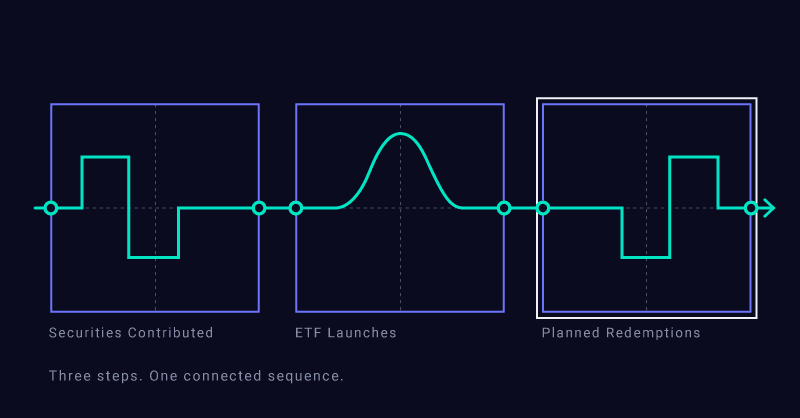
The fact pattern is narrow and, for anyone who has followed this market over the past two years, fairly recognizable. Investors contribute appreciated securities to a new ETF. Then, as part of a plan in place before launch, the fund significantly changes its composition by redeeming a large share of those securities out to an authorized participant (AP) an in kind transaction, not long after the contribution. The fund ends up holding a portfolio consistent with what its mandate calls for, however, that portfolio looks materially different from what the investors put in.
The IRS has determined to apply existing tax guidelines to read the whole sequence as one transaction. Leaning on step-transaction and substance-over-form doctrine, it treats the ETF as a conduit and the contributing investor as having swapped the redeemed securities with the AP in a taxable exchange. Nonrecognition treatment under 351 is lost for whatever securities were redeemed out under the plan. Bringing in a crowd of unrelated contributors doesn't help; the ruling says the result holds with multiple investors.
The ruling hangs on three things: the redemption was prearranged, it came shortly after the contribution, and the portfolio left behind is materially different. None of those is quantified. There's no holding period and no turnover percentage. "Shortly" could mean days or it could mean months, and the guidance doesn't say which.
Until further guidance arrives (the agencies have said more is coming, possibly with retroactive effect), conversions will be judged on their own facts. The most useful sentence in the whole package may be the one in the Notice saying it does not address seeding a new ETF with assets consistent with the fund's investment thesis that are "intended and expected to be retained," absent a substantial change in circumstances.
Where the Manager-Led Conversion Fits
When a manager decides converts its existing accounts to an ETF structure, such as consolidating SMA business to one or more ETF tickers, the contributed securities usually consistent with the manager’s strategy before the conversion. They were picked using the same investment processes the ETF will use after launch. The client owned a portfolio before and owns substantially the same portfolio afterward; what changed is the wrapper around it and how that is bought and sold. That sits much closer to the change-of-form transaction Section 351 was written for than to a portfolio swap.
Where It Still Gets Tricky
None of this means a manager-led conversion is automatically in the clear, and we'd be cautious about any framing that suggests otherwise. In our experience the harder questions come up in the weeks before launch while reviewing accounts down to their tax lots, markets continue to shift, and managers have current management responsibilities. If, for example, certain names get contributed to the ETF and are sold or redeemed out a month later, the post-launch portfolio starts to diverge from what was contributed, which is the very variable the ruling cares about.
Transition trading after launch should look like the manager's normal turnover. The investment rationale, expected holding periods and sequencing ought to be written down at launch, not pieced together once someone asks. And the tax opinion behind the deal rests on representations about how the fund will be run, so those representations need to hold up in practice and not only on paper.
What Comes Next
Comments are due October 28. The agencies have asked what facts would justify different treatment and how to protect established market practice, which suggests there is still some room for the picture to shift. They've also floated designating some of these transactions as transactions of interest or listed transactions, which would bring disclosure obligations for participants and material advisors, and they've said they can challenge deals under existing law in the meantime.
For a manager whose conversion really is a change of wrapper, we don't think the reasons to convert have gone anywhere. The bar for documenting it has gone up, though, and that is probably a healthy thing for this market.
This article is for informational purposes only and does not constitute tax, legal or accounting advice. ETC does not provide tax advice. Readers should consult their own tax, legal and financial advisors regarding their specific circumstances.
Exchange Traded Concepts, LLC (“ETC”) is an SEC Registered Investment Adviser. ETC presently offers two lines of business, the first being the provision of white-label ETF services, that include investment advisory and administrative platform services, and the second is offering its portfolio management services on a stand-alone basis to other advisers managing funds that have a need for a specialized trading sub-adviser familiar with and skilled in trading on behalf of an ETF and other investment vehicles. ETC provides the trust, board, and decades of experience to offer asset managers (hedge, SMAs, mutual) and others an efficient, cost-effective means to leverage the benefits of the ETF wrapper. ETC’s Form ADV can be found here https://adviserinfo.sec.gov/firm/summary/151197

Important Disclosures
Exchange Traded Concepts is an SEC Registered Investment Adviser. The Firm's Form ADV is publicly available and can be found here: https://www.adviserinfo.sec.gov/Firm/151197. ETC may be subject to various conflicts of interest in the provision of its services. Potential conflicts of interest shall be identified in the Firm's Form ADV. The Exchange Traded Funds are referred to as "Funds" for purposes of this document. ETC transacts business in the United States and other jurisdictions where it is properly registered or excluded or exempted from registration requirements. This document does not constitute an offer of services in jurisdictions where ETC does not have the necessary licenses.
No representation is made that any Fund's investment process, objectives, goals or risk management techniques will or are likely to be achieved or be successful or that any Fund or any underlying investment will make any profit or will not sustain losses. The risks of investing in a Fund will not be negated by ETC's Fund services, and no assurance is given that a Fund will not be exposed to risks of significant trading losses.
The information provided herein does not constitute tax, legal or accounting advice. ETC does not provide legal, financial, accounting or tax advice. Clients and prospective Clients, as well as investors and prospective investors in a Fund ("Investors") are advised to seek the counsel of their own legal, financial and tax advisors for all matters relating to the services and structures contemplated herein. Each Investor (either alone or with its professional advisors) is solely responsible for its own due diligence, risk assessment and tolerance, investment objectives, any decision to invest in a Fund, and for monitoring its investment for purposes of determining whether it wishes to remain invested in such product and whether such product continues to be appropriate for its circumstances and requirements.
The information provided herein: (a) is provided as of the date indicated, (b) is in summary only and is not complete, and (c) is subject to change at any time without notice. Certain information provided by ETC is based on third-party sources and, although generally believed to be reliable, has not been independently verified. ETC is not responsible for errors or omissions from these sources. No representation is made with respect to the accuracy, completeness, or timeliness of such information, and ETC assumes no obligation to update or otherwise revise such information. In no event will ETC be liable to any party for any direct, indirect, incidental, exemplary, compensatory, punitive, special or consequential damages, costs, expenses, legal fees or losses (including, without limitation, lost income or lost profits and opportunity costs) in connection with the use of the information contained herein, even if advised of the possibility of such damages. ETC and its respective employees and its affiliates hereby exclude, to the extent permitted by applicable law, all liability in connection with the use of the information herein.
Interests in Funds will not be insured by the FDIC, the SIPC or any other organization, will not be deposits of any bank, and are not guaranteed by any bank.